Some projects begin as ideas. Others begin as plans. Mehr Wins began as a feeling, long before it ever had a name, a website, or a clear shape in the world, and for a long time it lived quietly inside me without asking to be explained. It was more like a gravity than a concept, something that kept pulling my attention in the same direction even when I did not yet understand why. Looking back, I can see that it was already working on me long before I ever tried to give it a form.
The word Mehr is my personal way of saying Love Wins, but it has never felt like a simple translation to me. In Persian, Mehr carries meanings that go far beyond a single English word, reaching into ideas of love, kindness, affection, and human warmth, and also into the ancient image of the sun and its life giving light. It represents warmth, life, and truth all at once, and yet it does so in a way that feels gentle rather than loud or demanding. To me, this kind of love is not something that announces itself or needs to be proven. It lives quietly in everyday moments, in how people choose to treat one another when no one is watching, and in the small decisions to be present, patient, and kind. Mehr Wins grew out of that understanding, and out of a desire to give that quiet kind of love a form through words, images, and meaning.
Long before Mehr Wins existed as a project, Persian culture had already found a quiet place in my life. Even as a child, something as small as eating pistachios from Iran sparked a curiosity about a place that felt distant and mysterious, but also strangely familiar in a way I could not yet explain. I did not have language for it then, but I remember sensing that there was more to that part of the world than what I saw on the news or in movies. For many years, my understanding of Iran and Persian culture was shaped mostly by distance and by stories filtered through media, which are often flattened by politics and fear. That changed in 2014, when I watched Anthony Bourdain visit Iran on his show Parts Unknown. What stayed with me was not analysis or commentary, but a moment of simple, human surprise, when he said, “I am so confused. It wasn’t supposed to be like this. Of all the places, of all the countries, all the years of traveling, it’s here, in Iran, that I am greeted most warmly by total strangers.” That sentence stayed with me, because it quietly shattered a story I had been taught to accept without ever questioning.
From that point on, my interest was no longer abstract. It was no longer just curiosity about a faraway place or an idea of a culture. It became a desire to understand, to listen, and to see more clearly, not through headlines but through human experience. Over time, I was fortunate enough to form real friendships with people from Iran, and those relationships changed everything. These were not symbols or concepts or representations. They were people with humor, warmth, pain, resilience, and deeply human lives, and their kindness and values made everything I had been learning feel real and grounded. What had started as interest slowly became something rooted in real relationships and real respect, and Mehr Wins began to take on a much more personal meaning.
As I learned more, I also became more aware of how much meaning lives inside words themselves. The question of names, identity, and language is not simple, and it carries history, memory, and sometimes wounds. The word Persia comes from how the ancient Greeks referred to this land, based on a region called Parsa, while the name Iran is far older and comes from how the people of this land have described themselves for thousands of years, meaning the land of the Iranian people. Today, some prefer the word Persian because they feel the name Iran has been damaged by the actions of the Islamic Republic, while others proudly call themselves Iranian because their identity is deeper and older than any regime. I understand and respect both, and I do not see them as opposites. When I use the words Iran and Persian, I am always speaking about the same ancient culture, the same people, and the same deep and complex history, and I try to do so with care and humility.
Language itself became another doorway into this world. Persian is a deeply poetic and expressive language, and many of its words carry emotional landscapes that do not exist in quite the same way in English. Some phrases hold centuries of memory, and some words feel like they contain entire ways of seeing life. When I share Persian words or poetry, I am always sharing interpretations, not perfect translations. Something is always lost when one language is carried into another, but something can also be found in the attempt. That fragile, imperfect bridge between worlds is part of what Mehr Wins is trying to honor.
There is a famous line by the Persian poet Saadi that says that human beings are members of a whole, and that when one part is in pain, the others cannot remain at ease. That idea has stayed with me for a long time, not as a slogan but as a quiet moral truth. It speaks to a sense of shared humanity that feels desperately needed in a world that is constantly being taught to divide itself. This sense of connection and shared responsibility sits quietly at the heart of everything I am trying to do here. It is not always visible, and it is not always easy to live up to, but it remains a kind of inner compass. In many ways, Mehr Wins is simply an attempt to keep that compass from being forgotten.
At the same time, I am not blind to history. The relationship between Iran and the West is complex and often painful, and my own country is part of that story. There are wounds, mistrust, and long shadows that cannot be ignored or explained away. This project does not exist to argue politics or to simplify complicated realities. It exists from a personal place, from a desire to honor what is human, what is enduring, and what deserves to be remembered. I do not speak for anyone else, and I do not claim authority. This is only my own perspective, shaped by learning, relationships, and reflection, and I welcome thoughtful correction because my goal has always been respect, not certainty.
There is another truth that cannot be separated from this story, and it is the one written in the courage and suffering of the Iranian people themselves. For decades now, they have not stopped pushing back against a system that tries to erase their voice, their freedom, and their right to shape their own future. This did not begin recently, and it did not begin with one protest or one moment. Since 1979, there have been wave after wave of resistance, each one carrying the same quiet message, that a people with such a deep history do not forget who they are.
When you look at the richness of Iranian civilization, its poetry, its philosophy, its art, and its long memory of empires, thinkers, and ideas, it becomes impossible to believe that this spirit could ever be fully crushed. A culture that has survived for thousands of years does not simply disappear because of one regime. It stays alive in language, in family, in memory, and in the quiet refusal to accept humiliation as destiny.
As I am writing this, another uprising is unfolding. Many mark its beginning on December 28, 2025, and it is still ongoing as these words are being written. In the streets and in the voices of people, you can hear a phrase being repeated again and again, “This is the final battle, Pahlavi will return.” Their call includes the name of Reza Pahlavi, the Crown Prince and son of the last Shah of Iran, not as a casual slogan, but as a symbol of something many feel is lost and worth reclaiming. It is the sound of exhaustion, of courage, and of a people who feel they have reached a point where going back is no longer possible.
Many have paid for this with their freedom, and many with their lives. Those losses are not abstract. They are sons, daughters, sisters, brothers, neighbors, and friends, and they deserve to be remembered as more than numbers or headlines. Behind every name is a family, and behind every family is a wound that does not simply close.
I do not see these uprisings as politics in the ordinary sense. I see them as something older and deeper, the natural resistance of a people who know they are more than what they are being reduced to. It is the same force that has kept Iranian culture alive through invasions, collapses, and centuries of change. It is the insistence that identity, dignity, and memory are not things that can be permanently conquered.
This is also why the hope for a free Iran never truly disappears, no matter how many times it is pushed down. It is not just hope for a different government. It is hope for a return to continuity, to self respect, and to a future that is not built on fear. And it is why I believe, deeply and sincerely, that the sacrifices being made are not meaningless, even if the cost has been unbearably high.
Not long ago, I learned something through DNA research that added a quiet, symbolic layer to this journey. I discovered that part of my distant family history touches the same long and complex era as the Qajar period of Persia. It does not make me Persian, and it does not give me any special claim, but it did make me think more deeply about time, about history, and about how strangely interconnected human stories really are. It also made me think more about leadership and how often the lives of ordinary people are shaped by the choices of those in power.
My spiritual outlook has shaped this project in ways that are difficult to separate from my life itself. I am influenced by ancient wisdom, by Persian and Zoroastrian ideas, by Spiritism, and by the belief that life is a kind of classroom for the soul. In Zoroastrian thought especially, the idea of Good Thoughts, Good Words, and Good Deeds is not just a moral slogan but a way of aligning oneself with truth and light. I believe the world was created with a law of balance, and I try, imperfectly, to live in a way that respects that balance rather than constantly fighting against it. I also do not believe that people enter our lives by accident. Over time, I have come to see relationships and encounters as part of how we are taught what we are meant to learn, and as part of how the soul is slowly shaped.
There are lines attributed to Rumi that have always felt close to how I experience life. One says, “Let yourself be silently drawn by the strange pull of what you really love. It will not lead you astray.” Another says, “Try not to resist the changes that come your way. Instead, let life live through you.” I have never lived according to a neat plan or a straight line, and in hindsight that feels less like a failure and more like a kind of guidance. The more I look back, the more I can see that many of the most important turns in my life came not from control, but from listening.
I also understand myself through systems like astrology and Human Design, not as rigid rules but as mirrors for reflection and language for patterns I already felt inside myself. As a Scorpio, I am drawn to depth, to truth, and to transformation, and I have never been comfortable living only on the surface of things. In Human Design, I am a Manifesting Generator, which helped me accept that my path is not meant to be linear, and that my way of creating is to move in cycles of building, refining, abandoning, and returning again with more clarity. It taught me that my energy works in waves, not in straight lines, and that forcing myself into rigid structures only leads to burnout and disconnection.
Creativity, because of this, has never been just a hobby for me. It is how I process life, how I survive difficult periods, and how I make sense of things that once felt overwhelming or impossible to carry. It is how I turn confusion into shape and pain into something that can be looked at without turning away. Over time, all of these threads began to quietly weave together, and Mehr Wins grew out of that weaving, not as a business plan but as a necessity.
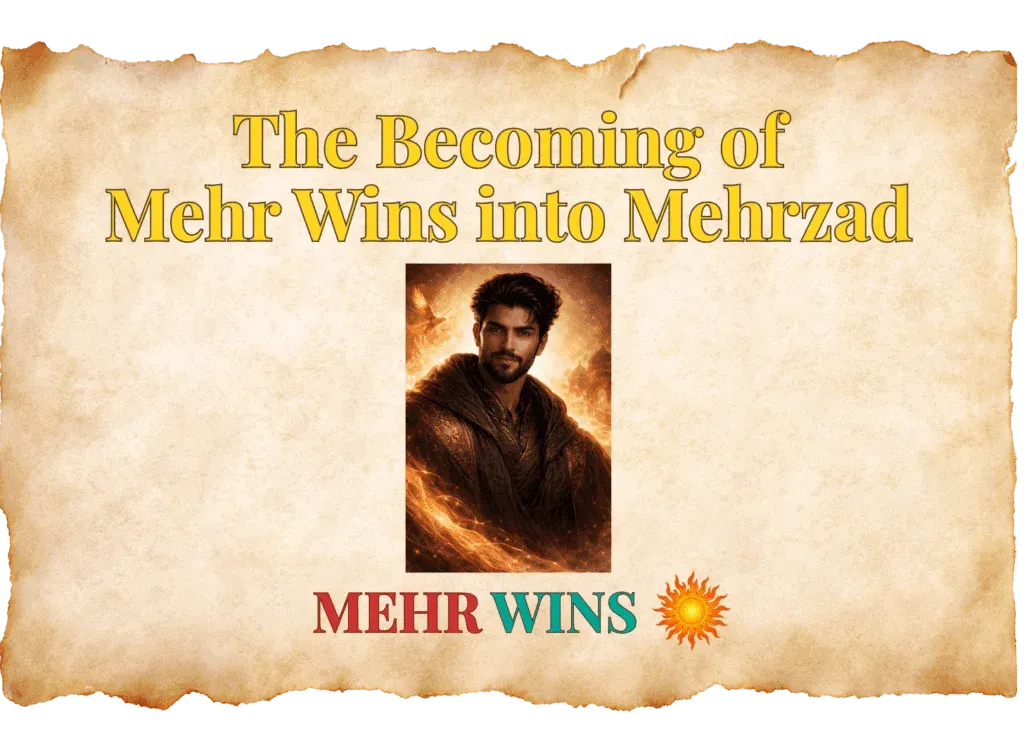
Along this path, a symbolic figure named Mehrzad began to take shape in my work. In some of my artwork and writing, you may see him appear from time to time, not as a real person and not as a stand in for me, but as a symbolic presence. Mehrzad is a way of giving form to ideas and feelings that have always existed in my work, and in many ways have always existed in me, but are now taking a clearer and stronger shape as I continue to focus more deeply on what I am creating.
Mehrzad represents the part of the human spirit that carries light, dignity, and meaning through darkness and noise without pretending that those things do not exist. He reflects endurance, inner strength, and the quiet decision to keep going with awareness and conscience intact. In that sense, he is not a character in a story, but a symbolic language, a way of expressing the inner journey, the witness, and the seeker that this entire project has always been about.
Over time, you will likely see Mehrzad appear more often in future artwork, designs, and posts as this symbolic thread becomes more central to my creative work. Not because I am becoming someone else, but because this is the direction my work, and in many ways my life, has been moving toward. I am still the creator, writer, and designer behind these projects. Mehrzad is not my identity and not a replacement for my voice. He is a visual and symbolic way of expressing themes that have always been present in my work, and a way to give form to the deeper emotional and philosophical direction my projects are continuing to grow into.
Mehr Wins is not about trends or algorithms. It is about intention. It is about choosing love over fear, light over darkness, meaning over noise, and depth over emptiness. Everything here is created with care, and every word, every symbol, and every design is meant to carry purpose, whether it exists as something to read, something to wear, or something to hold. More than anything, Mehr Wins exists because some things are worth protecting and carrying forward. It exists because culture, language, memory, and human dignity matter. It exists because in a world that often rewards cynicism, I still believe in light.
And in the end, if there is one thread that runs through all of this, it is the belief that meaning is not something we find once and keep forever, but something we return to again and again in different forms. Mehr Wins did not begin as a plan, and it is not meant to end as a finished statement. It is a living process, shaped by learning, by connection, and by the courage to keep choosing what is human in a world that often forgets.
Everything in this project, from words to images to symbols, comes from that same place of intention. It is an attempt to remember what matters when it would be easier to look away, and to choose light not because darkness does not exist, but because light is what helps us see. It is about carrying forward what is gentle, what is true, and what is worth protecting, even in small and imperfect ways.
I do not expect this work to change the world. But I do believe that small, sincere things change the people who encounter them, and that those changes matter. If Mehr Wins leaves someone feeling a little more grounded, a little more connected, or a little more willing to meet life with kindness instead of fear, then it has already done something real.
In that sense, this is not an ending at all. It is simply another beginning, and an open invitation to keep walking, keep learning, and keep choosing light.